


Lost Communities of Virginia Book

AVAILABLE AT LOCAL AND ONLINE BOOKSELLERS!
Winner of the 2012 Library of Virginia People’s Choice Award for Non-Fiction, the 2012 Preservation Virginia Outstanding Historic Preservation Research Effort Award, and 2013 American Association of State and Local History Leadership in History Award!
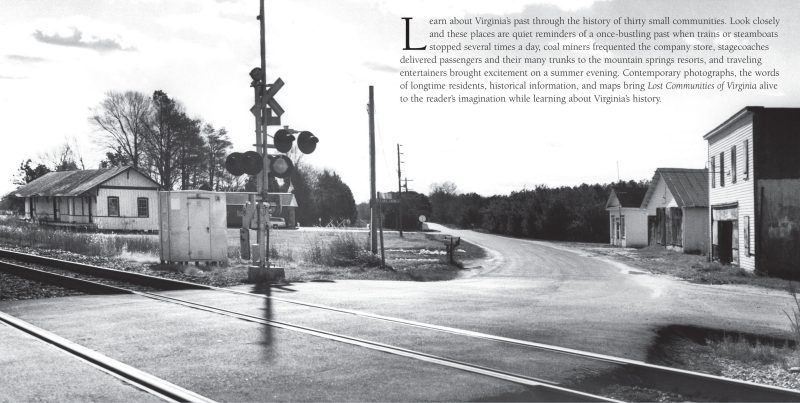
Virginia’s back roads and rural areas are dotted with traces of once-thriving communities. General stores, train depots, schools, churches, banks, and post offices provide intriguing details of a way of life now gone. The buildings may be empty or repurposed today, the existing community may be struggling to survive or rebuilding itself in a new and different way, but the story behind each community’s original development is an interesting and important footnote to the development of Virginia and the United States.
Lost Communities of Virginia documents thirty small communities from throughout the Commonwealth that have lost their original industry, transportation mode, or way of life. Using contemporary photographs, historical information, maps, and excerpts of interviews with longtime residents of these communities, the book documents the present conditions, recalls past boom times, and explains the role of each community in regional settlement.
Published In 2011 by Albemarle Books and distributed by the University of Virginia Press.
The 30 communities featured in the book are Almagro (Danville City), Boydton (Mecklenburg County), Branchville (Southampton County), The Bridge (Carroll County), Capeville (Northampton County), Clements Mill (Franklin County), Derby (Wise County), Doe Hill (Highland County), Eagle Rock (Botetourt County), Eggleston (Giles County), Jerome (Shenandoah County), Mendota (Washington County), Milford(Caroline County), Mineral (Louisa County), Moneta (Bedford County), Mount Solon (Augusta County), Mouth of Wilson (Grayson County), Newport (Giles County), Nortonsville (Albemarle County), Paint Bank(Craig County), Pamplin City (Appomattox County), Pamunkey Reservation (Prince William County), Pocahontas (Tazewell County), Riner (Montgomery County), Sharps (Richmond County), Stonega (Wise County), Sweet Chalybeate (Alleghany County), Troutdale (Grayson County), Uno (Madison County), and Woodford (Caroline County).
The Lost Communities of Virginia book received funding from the Graham Foundation for Advanced Studies in the Fine Arts, the Virginia Foundation for the Humanities, the Roller-Bottimore Foundation, book chapter sponsorships, merchandise sales, and private donations.
For more information, please contact the Lost Communities of Virginia Program Manager, Terri Fisher, tlfisher@vt.edu, 540-231-5644.